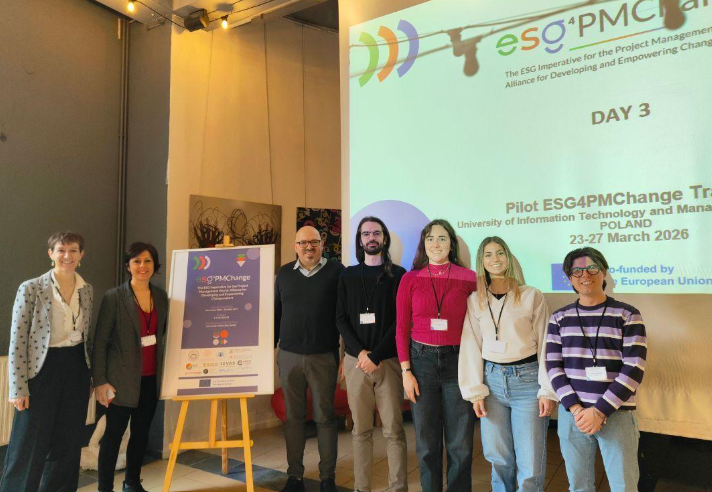
For many students, a training experience offers a chance to apply what they have learned in class. Sometimes, however, it becomes a moment that opens a new research path.
This happened to Anna and Ilaria, two MSc students from the University of Bologna, who took part in the ESG4PMChange training in Rzeszów, Poland, from the 23rd to the 27th of March 2026. Through practical activities, international teamwork, and reflection on real project management challenges, they began to look at Environmental, Social, and Governance (ESG) principles as a concrete lens for managing projects more responsibly.
Their experience shows that when students are invited to work and critically reflect on real problems and question the wider impact of their decisions, learning can become the starting point for deeper academic inquiry.
Seeing project management through a broader lens
Project management is often associated with planning, deadlines, resources, budgets, and deliverables. These elements remain essential. Yet, as organizations are increasingly expected to consider their environmental and social impact, project managers are also asked to think about the consequences of their decisions beyond the immediate project scope.
For Ilaria, this was one of the most meaningful insights from the training:
“What inspired me the most during the ESG4PMChange training was discovering a broader perspective on project management. I realized that managing a project is not only about achieving goals, but also about understanding the impact that decisions can have on people, organizations and society”
Her reflection captures an important shift. A project is also a set of choices that can affect stakeholders, communities, organizations, and future outcomes. Integrating ESG into project management means asking not only Can we deliver this project?, but also How should we deliver it, and with what impact?
ESG as a mindset
One of the challenges in discussing ESG is that it can sometimes be perceived as a separate requirement: an extra checklist, a reporting obligation, or a specialist topic. The ESG4PMChange training encouraged students to approach it differently.
Anna described this shift clearly:
“What resonated with me most was realizing that ESG is not a niche topic since it impacts many different sectors, and it is crucial to the world we live in today. Working on a group project and looking at the impact of our decisions as a ‘guiding lens’, instead of focusing only on goals and resources, felt like an innovative and interesting way to approach sustainability in project management”
The idea of ESG as a “guiding lens” is especially relevant for future project managers. It suggests that sustainability, responsibility, transparency, and stakeholder awareness should inform from the very beginning the way problems are framed, alternatives are evaluated, risks are assessed, and decisions are made.
In this sense, ESG integration becomes part of the project mindset and influences how teams define success.
Learning through multicultural collaboration
The training experience also highlighted the value of collaboration. Working in international teams gave students the opportunity to compare perspectives, negotiate priorities, and understand how ESG-related challenges may be interpreted differently across cultural, organizational, and sectoral contexts.
This matters because ESG project management requires dialogue among different actors: project teams, clients, suppliers, local communities, institutions, and end users. Learning how to listen, discuss, and make decisions collectively is therefore a primary skill, central to responsible project management.
For students, this type of learning connects theory with practice. It shows that ESG integration requires cooperation, negotiation, and conscious decision-making under real constraints.
All ESG dimensions matter
A further reflection emerging from the students’ experience concerns the need to consider all three dimensions of ESG. Environmental sustainability often receives the most attention, especially when discussing climate change, emissions, waste, or resource use. However, the social and governance dimensions are equally important in project contexts.
Anna emphasized this point:
“This experience helped me understand that all dimensions of ESG matter… not only the environmental one, but also the social and governance aspects, including transparency and long-term thinking. I dream of working in the cultural and educational field, and I really believe these topics will guide me becoming a more conscious professional that can integrate awareness, integrity and respect for people in each project I’ll participate in”
Her words underline a key learning outcome: ESG includes people, fairness, diversity, equity, inclusion, transparency, and long-term social value creation.
From training to MSc thesis
Perhaps the most tangible outcome of this experience is that both students decided to continue exploring ESG integration in their MSc theses. Ilaria explained
“This experience convinced me that the integration of ESG principles into project management is a topic worth exploring in my MSc thesis. I believe ESG is becoming increasingly important for organizations, as they are expected to create value not only from an economic perspective, but also from a social and environmental one”
This transition from training activity to research topic is significant. It shows that educational experiences can stimulate curiosity, critical thinking, and academic engagement. A well-designed training programme helps students identify questions that in their opinion deserve an answer.
How can ESG principles be embedded into project management practices? Which competencies do project managers need to apply them effectively? How can organizations move from formal ESG commitments to everyday project decisions? These are kinds of questions that future research can help address.
Why this experience matters
The experience of Anna and Ilaria offers a useful reminder for educators, project professionals, and organizations involved in sustainability transitions. If we want future project managers to integrate ESG principles meaningfully, we need learning environments that are practical, collaborative, and reflective.
Students need opportunities to test ideas, work with peers, and understand the real-world implications of project decisions. They also need space to connect professional skills with ethical awareness and long-term thinking.
In the end, ESG integration is not only a technical challenge. It is also an educational one.
The next generation of project managers will be asked to deliver projects in a world where success is increasingly linked to responsibility, transparency, and impact. Experiences like the ESG4PMChange training can help them begin that journey, not only as learners, but as future professionals (or eventually researchers).