
What if the success of a project was measured not only by budget and deadlines, but also by its impact on people and the planet? Today, organizations are under growing pressure to deliver projects that are not just efficient, but also responsible. ESG is no longer a “nice-to-have” topic reserved for sustainability teams. It is becoming a critical skill for project managers across industries. From construction and IT to education and healthcare, stakeholders now expect projects to create long-term value, reduce environmental harm, and improve transparency. The question is no longer “Should we include ESG in projects?” but rather “How can we do it effectively?”
Why ESG Matters in Project Management
Traditional project management focuses on three key elements:
- Time
- Cost
- Scope
But modern projects operate in a much more complex environment. Communities, investors, employees, and customers increasingly want organizations to act responsibly. This is where ESG changes the game by adding a “fourth dimension” to project success. A project delivered on time but damaging the environment or ignoring stakeholder concerns can still fail in the eyes of society.
The Three Core Pillars:
- Environmental Factors. These examine how projects affect the planet, including energy consumption, carbon footprint, waste reduction, and sustainable resource use.
- Social Factors. These focus on people, specifically employee well-being, diversity and inclusion, stakeholder engagement, and community impact.
- Governance Factors. These relate to ethical leadership and accountability, ensuring transparent decision-making, risk management, compliance, and responsible reporting.
The Shift from Compliance to Opportunity
Many organizations still approach ESG as a reporting obligation. But the most successful companies are treating it as an opportunity for innovation and competitive advantage.
A project manager who understands ESG can become a strategic leader rather than only a task coordinator. They can identify risks earlier, improve collaboration, and create projects that remain valuable long after delivery.
For example, companies that integrate sustainability into projects often discover:
- Lower operational costs through energy efficiency.
- Stronger stakeholder trust across the board.
- Better employee engagement and purpose.
- Increased investor confidence and funding opportunities.
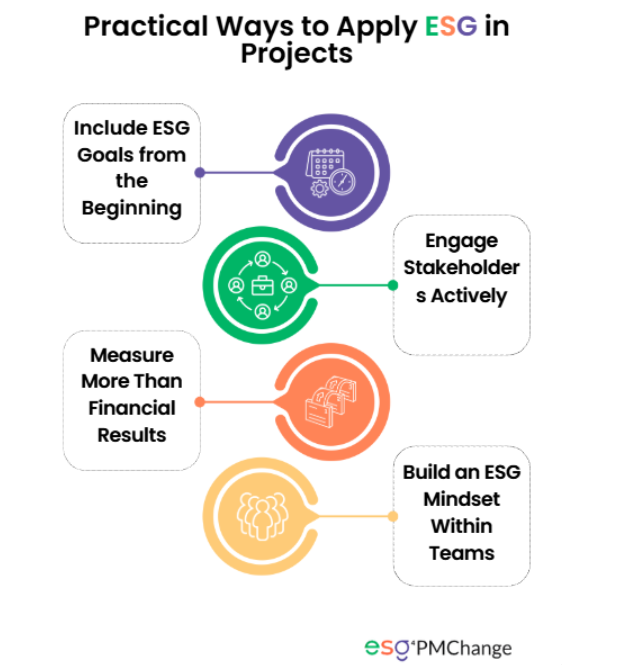
Practical Ways to Apply ESG in Projects
So how can project managers start integrating ESG into daily work? Here is a practical roadmap:
- Include ESG Goals from the Beginning
Do not treat sustainability as an afterthought. At the project planning stage, ask questions such as:
- How can we reduce waste?
- Who could be negatively affected by this project?
- How can we improve transparency?
Small questions early in the process can prevent major problems later.
2. Engage Stakeholders Actively
Projects impact different groups in different ways. Listening to employees, clients, local communities, and partners helps project teams identify risks and opportunities that might otherwise be ignored. Sometimes the best project insights come from the people least represented in meetings.
3. Measure More Than Financial Results
If you only measure budget performance, you only see part of the picture. What gets measured gets improved. Consider adding indicators such as:
- Energy and resource savings
- Diversity metrics
- Stakeholder and community satisfaction
- Ethical compliance and transparency scores
4. Build an ESG Mindset Within Teams
ESG is not one person’s responsibility. Project teams perform better when sustainability and ethics become part of everyday decision-making. Encourage open discussions, knowledge sharing, and continuous learning. Even small actions reducing unnecessary travel, improving communication transparency, or choosing sustainable suppliers can create meaningful impact over time.
The Future of Project Management
Project managers are no longer only delivery experts. They are becoming changemakers. As global challenges such as climate change, inequality, and resource scarcity continue to grow, organizations will increasingly rely on professionals who can balance business goals with long-term responsibility. The future belongs to project leaders who can combine strategy, empathy, and sustainability. Projects are no longer just about delivering outputs they are about creating positive outcomes.
Conclusion
ESG is transforming the project management world faster than many organizations expected. The good news? You do not need to become a sustainability expert overnight. Start with awareness, ask better questions, and gradually integrate ESG principles into your projects. Because in the future, successful projects will not only be remembered for what they delivered but also for how they delivered it.
What would change in your projects if ESG became part of every decision you made?

Dr Joanna Świętoniowska
is Director at the Centre for Didactic Development and an Assistant Professor in the Department of Management at WSIiZ. Her work focuses on project management, innovation, entrepreneurship, and gamification in education. She combines academic research with international project leadership and consulting.

Marlena Szczur
is an early-career researcher and Business Analytics specialist at the Centre for Didactic Development at WSIiZ. She focuses on quantitative research, data analysis, and evidence-based studies in learning and sustainability-related topics, including greenwashing and responsible communication.