
“Green”, “sustainable”, “climate-friendly”, “ESG-aligned” — these words are now everywhere in business communication. They appear in strategies, investment plans, project proposals and annual reports. But one question remains difficult:
How do we know whether a project is really green?
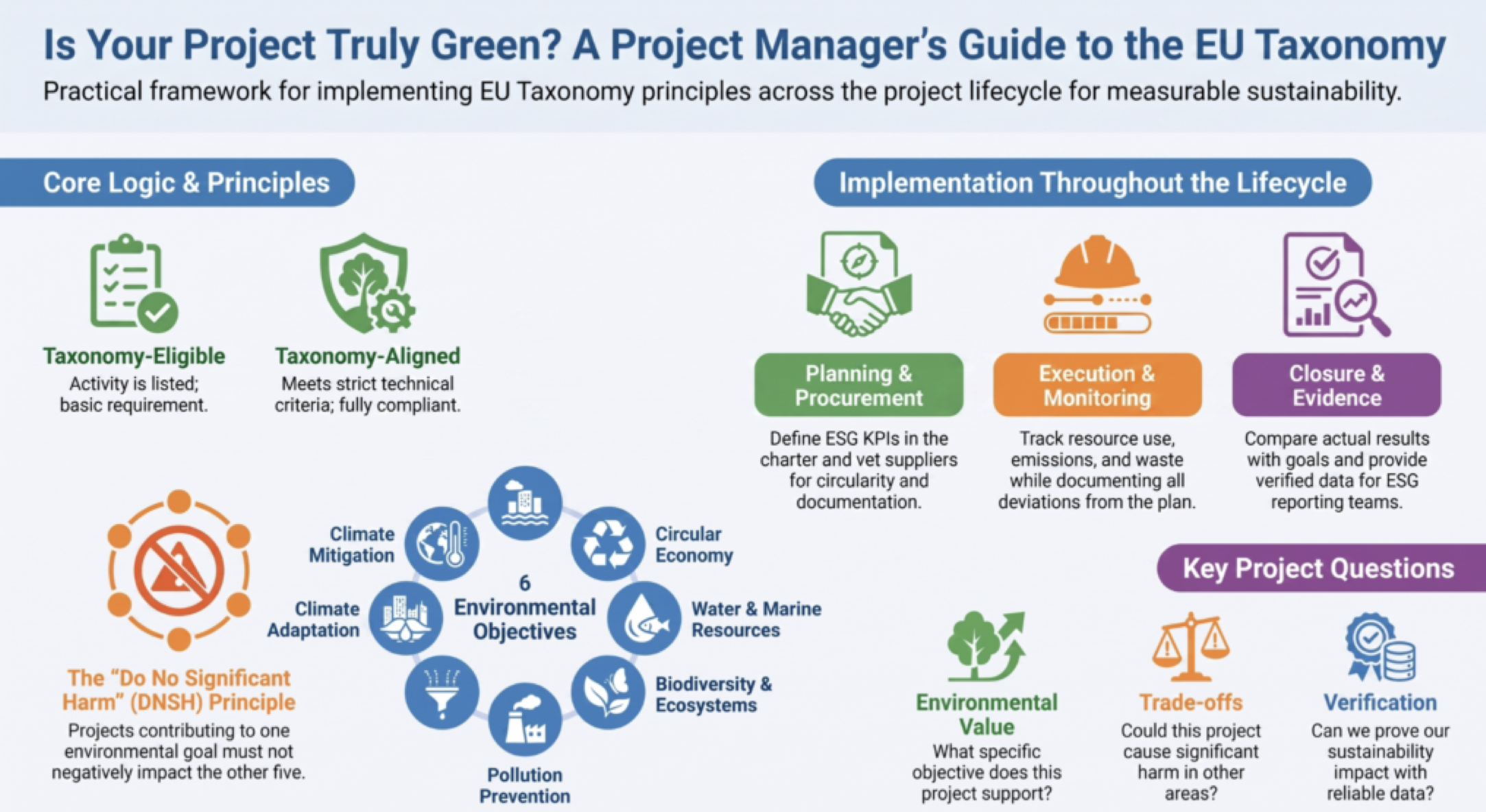
This is where the EU Taxonomy becomes useful. It was created as a common classification system for environmentally sustainable economic activities. In simple terms, it helps define which activities can be considered sustainable and under what conditions.
For project managers, this may sound like a topic for finance, compliance or sustainability teams. But in practice, many taxonomy-related questions are answered through projects: what is being built, purchased, changed, measured and documented.
Project managers do not need to become taxonomy lawyers. But they do need to understand the logic behind it.
What is the EU Taxonomy?
The EU Taxonomy is part of the European sustainable finance framework. Its purpose is to create a common language for identifying environmentally sustainable economic activities and supporting investment in the transition to a more sustainable economy.
It does not simply label a company as “good” or “bad”. Instead, it looks at specific economic activities. A company may have some activities that are covered by the taxonomy and others that are not.
A useful distinction is between two terms:
• Taxonomy-eligible means that an activity is included in the taxonomy framework.
• Taxonomy-aligned means that the activity meets the required conditions and technical screening criteria.
This difference matters. A project may take place in an area covered by the taxonomy, but that does not automatically make it sustainable. To be aligned, it must meet more demanding requirements.
The six environmental objectives
The EU Taxonomy is built around six environmental objectives:
• climate change mitigation,
• climate change adaptation,
• sustainable use and protection of water and marine resources,
• transition to a circular economy,
• pollution prevention and control,
• protection and restoration of biodiversity and ecosystems.
A sustainable activity should substantially contribute to at least one of these objectives. But that is not enough.
It should also avoid doing significant harm to the others. This is known as the Do No Significant Harm principle, often shortened to DNSH.
For example, a renewable energy project may contribute to climate change mitigation. But project teams still need to consider other impacts: land use, biodiversity, waste, water, supply chain risks or local community concerns.
This is why taxonomy thinking is useful in project management. It prevents us from looking at only one positive aspect while ignoring the wider consequences.
Three questions every project manager should ask
The EU Taxonomy can be complex, but its basic logic can be translated into three practical project questions.
1. What environmental objective does this project support?
A project described as green should be clear about the environmental value it creates.
Does it reduce emissions? Improve energy efficiency? Support climate adaptation? Reduce waste? Improve water management? Protect biodiversity?
If the answer is vague, the project may need clearer goals and indicators.
2. Could the project cause significant harm elsewhere?
This is often the harder question.
A project can support one environmental goal and still create negative effects in another area. For example, an energy efficiency project may rely on materials with poor circularity. A new infrastructure project may reduce emissions but affect ecosystems. A digital project may reduce paper use but increase energy demand from data systems.
Project managers are well placed to identify these trade-offs early, when changes are still possible.
3. Can we prove the impact with data?
Good intentions are not enough. Taxonomy alignment depends on evidence.
Project teams should ask:
• What data will we need?
• Who owns it?
• How often will it be collected?
• Can it be verified?
• Where will it be stored?
• Will it be useful for reporting later?
This connects taxonomy thinking directly with project governance. Without reliable data, even a strong sustainability claim may be difficult to defend.
A simple example: green office renovation
Imagine a company renovating its office and presenting the project as a “green renovation”.
A project manager could ask:
• Will the renovation reduce energy consumption?
• Are efficient heating, cooling or lighting systems being installed?
• What happens to construction waste?
• Are materials durable, low-emission or recyclable?
• Does the project improve indoor air quality and employee well-being?
• Are there baseline and post-renovation data to prove improvement?
The renovation becomes more credible not because it uses the word “green”, but because it is supported by criteria, data and evidence.
Why this matters for ESG4PMChange
The EU Taxonomy shows why ESG competencies are becoming important for project managers.
Modern project management is no longer only about time, budget and scope. Project managers increasingly need to understand environmental objectives, stakeholder expectations, technical criteria, data quality, governance and long-term value creation.
This is exactly the kind of shift ESG4PMChange addresses. The project aims to support the integration of ESG principles into project management education, training and professional practice.
Future project managers do not need to become sustainability reporting specialists. But they should understand how project decisions influence sustainability performance — and how to make that performance measurable.
Conclusion
“Green” is easy to say. Sustainable is harder to prove.
The EU Taxonomy helps move the conversation from intention to evidence. It gives organizations a more structured way to assess environmental sustainability and helps project teams ask better questions before, during and after project delivery.
For project managers, the key lesson is simple: if a project claims to create environmental value, that value should be planned, measured and documented from the beginning.
What would change in your next project if you had to prove its environmental contribution from day one?
CTA:
Take a look at one project you are currently planning or managing. Can you clearly explain what environmental value it creates, what risks it may generate, and what evidence you would use to prove its impact?
Start with one project, one environmental objective, and one measurable indicator. That is often the first step from a “green” intention to a credible sustainability outcome.
Further reading
European Commission: EU taxonomy for sustainable activities
European Commission: Taxonomy Regulation
Joint Research Centre: EU Taxonomy
Author

Elżbieta Szczepaniak
Business and project management expert, co-founder of Revas – Business Simulation Games offering business management simulation games with sustainability modules.