
ESG is often discussed as a matter of strategy, regulation, reporting or reputation. Organizations set sustainability goals, prepare policies and communicate commitments. Yet when the time comes to prove progress, many face the same problem: the data is missing, scattered or difficult to verify.
This is where project management enters the ESG conversation.
Projects are where many sustainability-related decisions actually happen: resources are used, suppliers are selected, teams are formed, risks are managed, stakeholders are engaged and outcomes are delivered. If projects create ESG impact, they should also create ESG evidence.
Why ESG data is a project management issue
ESG data does not appear magically when a report needs to be written. It is created much earlier — during everyday business activities and project decisions.
Projects are often where important sustainability-related information is generated: in procurement decisions, technical documentation, energy use, material choices, training records, stakeholder consultations, supplier information, risk registers and project closure reports.
For example, a modernization project may generate data on energy consumption before and after implementation. A training project may provide evidence of employee development. A supply-chain project may document supplier screening. A community project may record stakeholder engagement and feedback.
The problem is that this evidence is often not planned in advance.
If no one decides what should be measured, who should collect it and where the evidence should be stored, the organization may struggle later — even if the project itself created real environmental or social value.
Common ESG data problems
Many organizations do not struggle because they lack good intentions. They struggle because data collection was not designed into the project.
Typical problems include:
• data is collected too late,
• no one clearly owns the data,
• indicators are vague or inconsistent,
• evidence is stored in emails, spreadsheets or separate systems,
• supplier documents are missing,
• project teams do not know what ESG information may be needed later,
• sustainability is added as a narrative after the project is already finished.
This creates a gap between what an organization wants to report and what it can actually prove.
A project may genuinely improve environmental or social performance, but without baseline data, indicators and evidence, the result becomes difficult to communicate credibly.
ESG Data by Design
Project managers can help solve this problem by treating ESG data as part of project design, not as an afterthought.
A simple starting point is to ask a few questions at the beginning of every relevant project:
• What environmental, social or governance outcomes could this project influence?
• Which indicators should we measure?
• What baseline data do we need before the project starts?
• Who is responsible for collecting each data point?
• How often should the data be collected?
• Where will the evidence be stored?
• Who will need this information after the project ends?
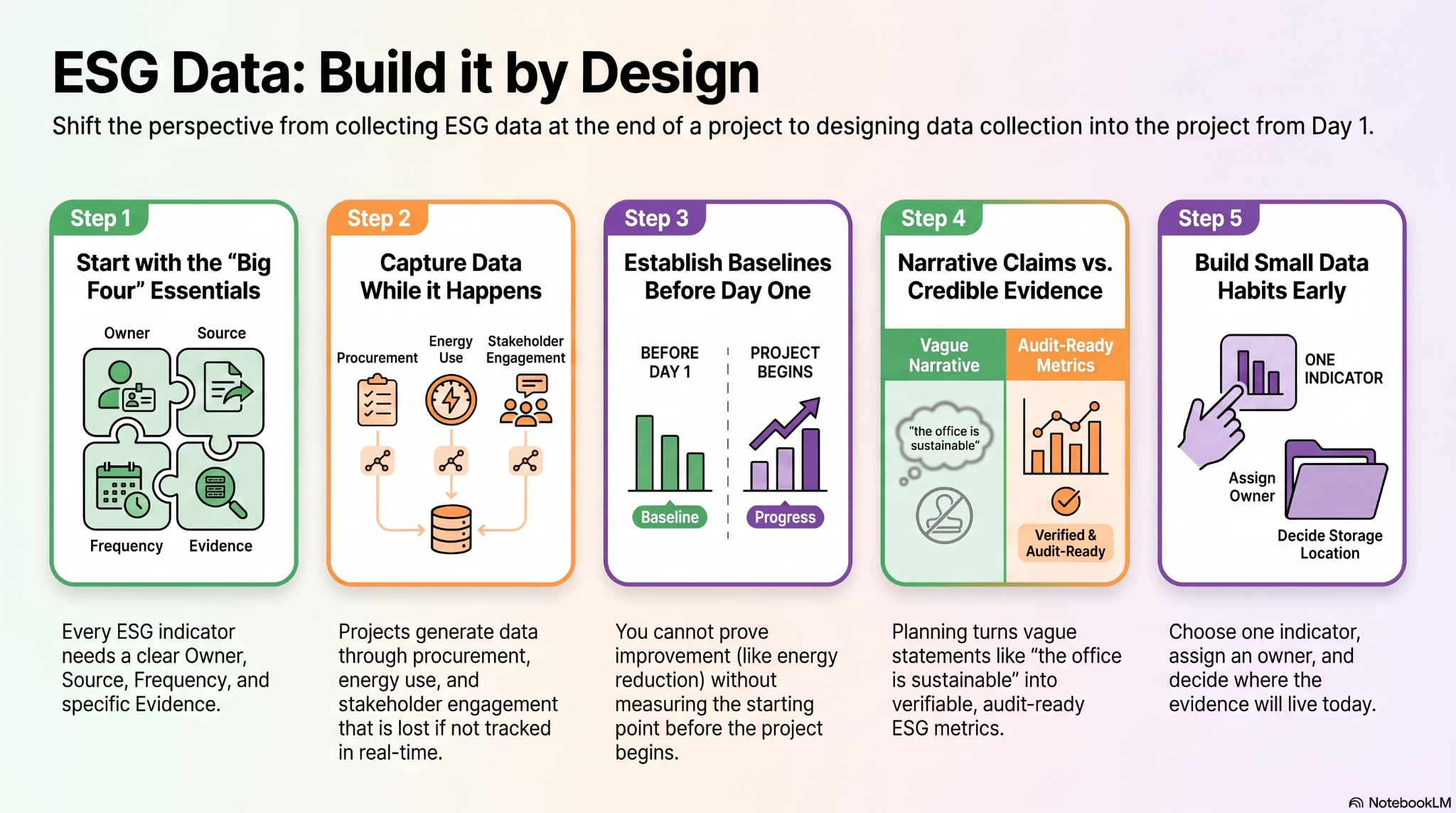
Every ESG indicator should have four basic elements: owner, source, frequency and evidence.
This does not mean that every project needs a complex sustainability dashboard. Often, a simple data plan is enough. What matters is clarity: who collects what, from where, when and why.
A simple example: office modernization
Imagine a company modernizing its office to reduce energy use and improve working conditions.
Without ESG data planning, the project may finish successfully, but the organization may only be able to say: “The office is now more sustainable.”
With ESG data planning, the project team can do more. It can measure energy consumption before and after modernization, document the technical parameters of new equipment, record waste management practices, collect employee feedback and store supplier documentation.
The difference is not only better reporting.
The difference is better learning. The organization can see what worked, what did not and how similar projects can be improved in the future.
Why this matters for ESG4PMChange
The ESG4PMChange project focuses on integrating ESG principles into project management education, training and professional practice. One important part of this shift is data awareness.
Future project managers do not need to become sustainability reporting specialists. But they should understand how their decisions influence ESG performance and how project evidence can support credible reporting.
This requires new competencies: defining indicators, assigning data ownership, documenting decisions, understanding stakeholder input and connecting project outcomes with wider sustainability goals.
In this sense, ESG data is not only a reporting issue. It is a project management competence.
Conclusion
Look at one project your organization is currently planning or managing. What ESG data will it generate — and who is responsible for collecting it?
Choose one indicator, define its owner, and decide where the evidence will be stored. Small data habits built early can make ESG reporting much easier later.
CTA:
Take a look at one project you are currently planning or managing. Can you clearly explain what environmental value it creates, what risks it may generate, and what evidence you would use to prove its impact?
Start with one project, one environmental objective, and one measurable indicator. That is often the first step from a “green” intention to a credible sustainability outcome.
Author

Elżbieta Szczepaniak
Business and project management expert, co-founder of Revas – Business Simulation Games offering business management simulation games with sustainability modules.