

Introduction
ESG reporting in Poland is no longer a distant European policy discussion. It is becoming a core part of the everyday business landscape. With the implementation of the Corporate Sustainability Reporting Directive (CSRD) into Polish law, sustainability information is moving closer to financial reporting, audit processes, governance systems, and operational decision-making.
For project leaders, this shift matters more than it may seem at first glance.
Why? Because ESG reports are not created in a vacuum or solely within corporate reporting departments. They are built from data, decisions, processes, risks, outcomes, and evidence generated across the entire organization. And a vast amount of that operational reality is created inside projects.
From Regulation to Polish Project Reality
Poland formally integrated the CSRD into national law through a major overhaul of the Polish Accounting Act (Ustawa o rachunkowości). The new framework completely redefines how sustainability is treated—moving it from PR brochures into the corporate activity report (sprawozdanie z działalności), tightly integrated with financial statements. Furthermore, the Polish Chamber of Statutory Auditors (Krajowa Rada Biegłych Rewidentów) is introducing the National Assurance Standard (Krajowy Standard Atestacyjny KSA 3002PL). This means sustainability data in Poland will face rigorous, independent audits.
However, navigating Polish legislation requires attention to timing. Following the EU’s “stop-the-clock” initiatives, recent updates to the Polish Accounting Act introduced optional exemptions for selected entities for the 2025 and 2026 reporting periods, shifting deadlines for the second and third waves of companies.
So, should Polish project leaders simply wait?
Not at all. In Poland, the market mechanism moves much faster than the legislator. Poland is a vital manufacturing and operational hub for Western European companies. Even if a Polish enterprise does not yet have a legal obligation to report, its international clients, major banks (evaluating ESG risks before granting corporate loans), and public procurement bodies already require granular ESG data. For a Polish company, failing to provide this data means losing tenders and facing higher financing costs today, not in 2028.
Why Polish Project Managers Hold the Keys to ESG Data
In the Polish business reality, ESG is often perceived as a bureaucratic exercise managed by a separate compliance team in Warsaw. But when you look at where the data originates, the focus shifts directly to project teams.
Consider how standard projects in Poland directly impact corporate ESRS compliance:
Infrastructure & Construction: Driven heavily by EU-funded operational programs (like FENG), infrastructure projects in Poland must strictly adhere to the “Do No Significant Harm” (DNSH) principle. A Polish PM managing a site directly controls local waste management, sourcing of materials, and subcontractors’ health and safety—all critical elements for corporate environmental reporting.
IT & Digital Transformation: With Poland’s booming IT sector, software and cloud migration projects heavily impact social and governance criteria. Polish project leaders influence data security (compliance with Polish KRI and GDPR regulations), digital accessibility (WCAG standards, increasingly demanded in Polish public sectors), and employee upskilling.
Supply Chain & Logistics: Under CSRD, Polish companies must map their entire value chain (Scope 3 emissions). Because Poland acts as a logistics gateway, PMs optimization of transport routes, warehousing energy efficiency, and local supplier selection directly determine the company’s carbon footprint.
Polish project managers do not need to read hundreds of pages of the Accounting Act. But they must realize that a project launched without an ESG mindset will produce chaotic data, making it impossible to pass a Polish statutory auditor’s review.
What Should Project Leaders Do Now?
The practical starting point is not a 200-page ESG strategy. It is a better project setup.
First, consider ESG in the Project Charter. Alongside scope, time, budget, and quality, project leaders should define ESG-relevant outcomes (e.g., energy efficiency, responsible procurement, stakeholder inclusion, or data transparency).
Second, assign an owner to every ESG indicator. One of the biggest reporting challenges is not a lack of ambition, but a lack of traceable data. Who collects the data? How often? Is it verifiable? Project managers are perfectly positioned to build these questions into project governance.
Third, embed ESG into Risk Management using “Double Materiality”. This means looking both ways: how the project impacts the environment and society (inside-out), and how external sustainability risks—like extreme weather events, supply chain disruptions, or shifting labor laws—create financial risks for the project’s budget and timeline (outside-in).
Fourth, elevate Stakeholder Engagement. ESG requires listening to people affected by the project, understanding their expectations, and responding to concerns. For many projects in local Polish communities, this social acceptance is the strongest source of legitimacy.
Finally, capture ESG learning at Project Closure. What was achieved? What data was collected? Which ESG assumptions turned out to be correct? This turns compliance into organizational learning, not just paperwork.
A Simple Project-Level ESG Checklist
To shift ESG from a last-minute reporting burden to a natural project management habit, project leaders can use the following framework before and during a project.
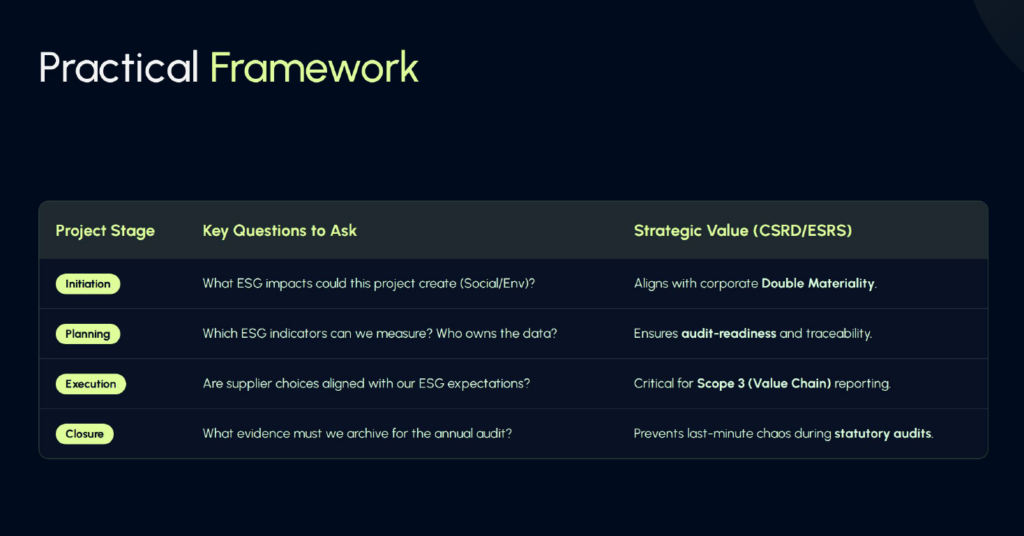
| Project Stage | Key Questions to Ask | Why it Matters for CSRD / ESRS |
| Initiation | What environmental, social, and governance impacts could this project create? | Aligns the project with the company’s materiality assessment. |
| Planning | Which ESG indicators can realistically be measured, and who owns the data? | Ensures data traceability and audit-readiness from day one. |
| Execution | Are supplier choices and procurement aligned with our ESG expectations? | Directly impacts Scope 3 (Value Chain) reporting and due diligence. |
| Closure | What should be documented now so the organization does not struggle later? | Prevents last-minute chaos when statutory auditors request evidence. |
How ESG4PMChange Solves the Polish Competence Gap
The rapid implementation of the Polish Accounting Act amendments has revealed a glaring market reality: a massive competence gap. While Polish sustainability executives understand the legal requirements of the CSRD, operational project teams often lack the tools to translate these laws into daily project execution.
This is precisely where the ESG4PMChange project steps in. It bridges the gap between high-level Polish corporate strategy and practical project delivery.
By developing structured learning frameworks, micro-credentials, and practical toolkits, ESG4PMChange equips Polish project professionals with concrete skills: from setting up ESG-compliant procurement criteria under Polish market conditions to managing stakeholder expectations and establishing auditable data paths. The project ensures that as the Polish economy undergoes this regulatory transformation, our project leaders are trained not just to check a compliance box, but to lead responsible, high-impact change.
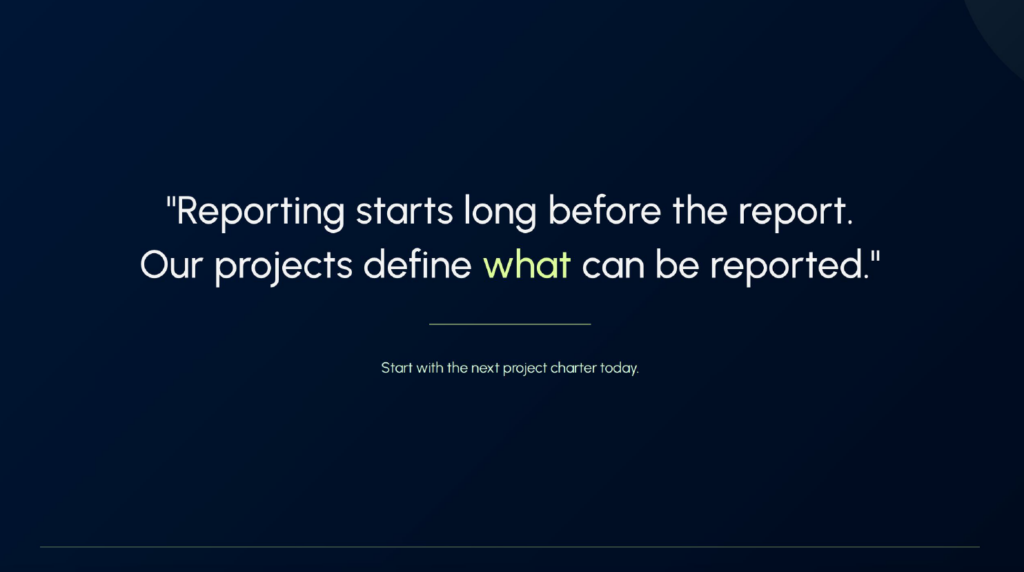
Conclusion: Reporting Starts Long Before the Report
ESG reporting in Poland is entering a mature phase. Regulations may define who reports and when, but projects define much of what can actually be reported.
For project leaders, the message is clear: do not wait for the reporting deadline. Start with the next project charter, the next risk register, the next procurement decision, and the next stakeholder meeting. ESG becomes manageable when it becomes part of how projects are designed and delivered.
The question is no longer just: “Is our organization ready to report?”
The better question is: “Are our projects creating the kind of evidence, impact, and value we would be proud to report?”
Author

Elżbieta Szczepaniak
Business and project management expert, co-founder of Revas – Business Simulation Games offering business management simulation games with sustainability modules.