
In today’s world, new regulations and standards require organizations to integrate sustainability principles into their operations. But what happens when the story and reports sounds better than the reality? That’s where greenwashing begins.
What Is Greenwashing?
Greenwashing is the practice of making a company, product, or service appear more environmentally friendly than it actually is. Think of it as a “green filter” applied to marketing.
Common examples include:
- vague claims like “eco-friendly” or “natural” without proof
- highlighting one positive action while ignoring bigger environmental harm
- using misleading labels or self-created certifications
It works because people want to make responsible choices and companies know it.
Why Do Organizations Use Greenwashing?
The pressure to be sustainable comes from everywhere:
- customers
- investors
- regulators
But real change is not easy. It often requires time, investment, and structural transformation. For some organizations, greenwashing becomes a shortcut a way to gain trust without doing the hard work.
The problem? It rarely holds up under scrutiny.
The Real Consequences
Greenwashing is not just a marketing issue. It has real impact.
- Loss of trust
Once customers realize they’ve been misled, credibility is hard to rebuild.
- Legal risks
Regulators are increasingly cracking down on false environmental claims.
- Slower progress
Greenwashing distorts the market and undermines companies that are genuinely trying to improve.
Case Study: Certification or Confusion?
A commonly discussed example in sustainability debates is a cotton certification system designed to support more responsible global cotton production.
Many major brands use such labels to signal more responsible sourcing. However, the system has faced criticism:
- it does not always ensure full traceability of cotton from farm to final product
- it is based on a mass balance model (mixing certified and non-certified material)
- consumers may assume stronger environmental guarantees than what is actually delivered
This creates a grey area:
Is this a real step toward sustainability, or a form of “soft” greenwashing?
The answer is nuanced. Such systems can contribute to improved farming practices, but the way they are communicated can sometimes oversimplify or overstate their impact.
Certifications: Trustworthy or Misleading?
Certifications are meant to help consumers make better choices but not all labels are equally reliable.
Trustworthy certifications usually include:
- independent third-party verification
- clear, measurable standards
- transparency and public reporting
Be cautious when you see:
- vague or unfamiliar labels
- lack of traceability
- no publicly available criteria
Examples of more widely recognized systems include:
- Fairtrade
- FSC (Forest Stewardship Council)
- EU Ecolabel
A label alone does not guarantee sustainability, it is essential to understand what lies behind it.
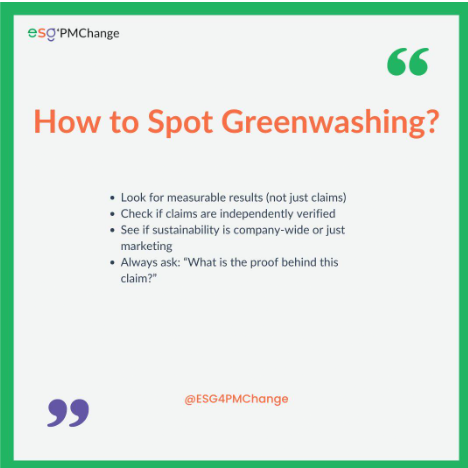
How to Spot Greenwashing
Ask yourself:
- Are there measurable results (e.g., % reduction in emissions)?
- Are claims verified by independent organizations?
- Is sustainability embedded across the entire business, or only used in marketing?
Red flag: big promises with little evidence.
What Organizations Should Do Instead
Be transparent
- Share where you are today, including challenges and limitations.
Set measurable goals
- define targets
- track progress
- report openly
Integrate sustainability into strategy
- Not just communication real operational change.
Educate internal teams
- Internal understanding reduces the risk of misleading external messaging.
Why Authenticity Pays Off
Organizations that act authentically gain:
- customer trust
- competitive advantage
- investor confidence
- stronger employer branding
Greenwashing may improve perception today, but it damages credibility tomorrow.
Instead of asking:
“How can we look sustainable?”
organizations should ask:
“What can we genuinely improve?”

Dr Joanna Świętoniowska
is Director at the Centre for Didactic Development and an Assistant Professor in the Department of Management at WSIiZ. Her work focuses on project management, innovation, entrepreneurship, and gamification in education. She combines academic research with international project leadership and consulting.

Marlena Szczur
is an early-career researcher and Business Analytics specialist at the Centre for Didactic Development at WSIiZ. She focuses on quantitative research, data analysis, and evidence-based studies in learning and sustainability-related topics, including greenwashing and responsible communication.