
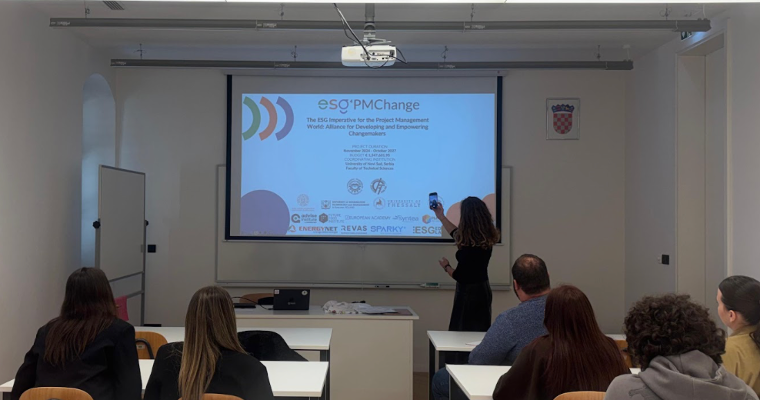
Second-year graduate students at the University of Split explored how environmental, social, and governance principles can support project and crisis management in the hospitality industry through a presentation of the ESG4PMChange project.
The event was organised by the University of Split at the Independent Study of Hotel Management and Gastronomy, Makarska Campus, as part of the Erasmus+ project “The ESG Imperative for the Project Management World: Alliance for Developing and Empowering Changemakers – ESG4PMChange.”
Connecting ESG with Hospitality Crisis Management
Delivered within the course Crisis Management in the Hospitality Industry, the presentation introduced students to the ESG4PMChange project and the fundamental principles of environmental, social, and governance standards.
The activity demonstrated how ESG considerations can be connected with challenges faced by hospitality organisations, particularly when planning projects, responding to crises, and making responsible management decisions.
By placing ESG principles within the context of hospitality and gastronomy, the event helped students understand their practical relevance beyond regulatory and administrative requirements.
Preparing Students for Sustainable Project Practice
Participants were second-year graduate students enrolled in the Hospitality and Gastronomy Master’s programme at the University of Split.
During the presentation, students were introduced to sustainable project management and informed about newly developed project management curricula based on ESG principles. The activity aimed to encourage academic interest and strengthen student engagement with approaches that are becoming increasingly important in contemporary business and project environments.
Students showed particular interest in the practical application of ESG principles, highlighting the value of connecting theoretical knowledge with challenges they may encounter in their future professional work.
Strengthening ESG Awareness in Higher Education
By integrating ESG4PMChange topics into a hospitality-focused course, the event contributed to greater awareness of responsible project management among future hospitality professionals.
The activity also supported the wider objectives of ESG4PMChange by connecting higher education with sustainable management practices and helping students develop knowledge relevant to changing professional and market expectations.
The event was documented through photographs, supporting the visibility and further dissemination of the ESG4PMChange project and its educational activities.