
In today’s world, where climate change headlines or lack of humanity dominate the news while consumers demand more responsibility from brands, ESG principles are no longer optional but crucial. Yet, many businesses and educational institutions still lag in understanding and adopting them fully. This is where project management steps in as a game-changer, slipping ESG into everyday operations and curricula through the back door, but making a massive positive impact.
DEMYSTIFYING THE SLOW UPTAKE OF ESG
Despite broad awareness, ESG adoption remains uneven. One of the biggest obstacles is misalignment with core business objectives. ESG is often perceived as a cost or a reputational add-on rather than a driver of long-term value. When short-term financial pressures dominate, sustainability investments can feel difficult to justify, even though evidence increasingly shows their efficiency and resilience benefits over time.
Education plays a critical role here. ESG concepts are still underrepresented in project management curricula, leaving future professionals without the skills needed to operationalize sustainability. Without practical exposure, ESG remains theoretical rather than actionable.
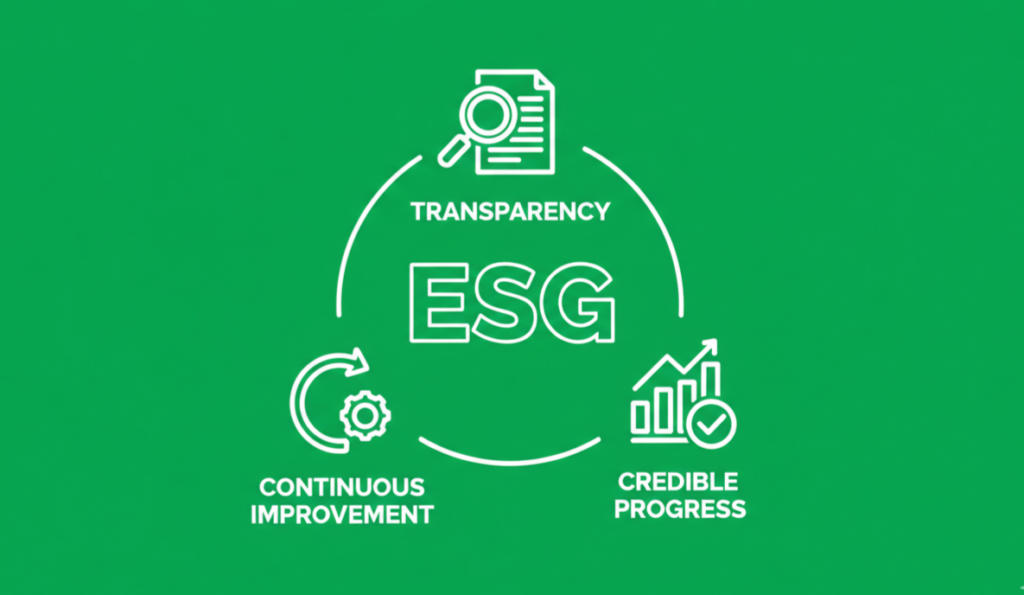
Fear of greenwashing further slows progress. Organizations hesitate to act, worried that imperfect initiatives will be publicly criticized. Yet ESG is not about perfection, it is about transparency, continuous improvement, and credible progress. Without clear metrics and governance structures, however, many companies struggle to demonstrate value or gain stakeholder confidence.
The good news is that these barriers are not structural flaws, they are implementation gaps. And project management offers a practical pathway to close them.
HOW SUSTAINABLE PROJECT MANAGEMENT (SPM) MAKES THE DIFFERENCE
Sustainable Project Management (SPM) applies an ESG lens across the full project life cycle: from planning and procurement to execution and evaluation. Environmental impact, social responsibility, and governance are treated as design criteria, not afterthoughts.
This works because projects are the core delivery mechanism of organizations. When ESG is built into projects, it becomes part of daily decisions rather than abstract strategy. Supply chains are assessed for ethical sourcing, resource use is optimized, and stakeholder impacts are considered early, when change is still affordable.
In education, SPM can reshape learning outcomes. Student projects can incorporate sustainability constraints, community impact, or circular design principles, ensuring that graduates enter the workforce ESG-ready rather than ESG-aware.
Organizations applying SPM report tangible benefits: reduced resource costs, improved risk management, stronger stakeholder trust, and higher employee engagement. ESG enters through “small doors,” but once embedded, it reshapes organizational culture.
REAL-WORLD EXAMPLES AND PRACTICAL TIPS
Let’s make ESG real with some standout examples. For the Environmental side, Microsoft’s sustainability project slashed emissions by powering data centers with renewable energy, avoiding millions of tons of CO₂ while boosting sales by $10 billion. This shows how aligning ESG with business goals can yield both environmental and financial rewards. On the Social front, Accenture’s “Diversity & Inclusion 360” project baked inclusivity into team structures, lifting employee engagement by 20% and client satisfaction by 17%. By prioritizing diverse perspectives, Accenture not only improved workplace morale but also strengthened client relationships. For Governance, Siemens leads with transparent ESG reporting, earning top spots in the Dow Jones Sustainability Index through rigorous project audits. Their commitment to clear, accountable processes sets a benchmark for others.
These cases highlight a shared lesson: ESG succeeds when it is tied to execution, accountability, and data.
Ready to try it? Here’s your SPM toolkit:
- Audit impacts: Identify one environmental or social impact and set a realistic improvement target.
- Broaden teams: Include diverse perspectives to improve decision quality and social outcomes.
- Define ESG goals: Use simple checklists to track progress across E, S, and G dimensions.
- Train pragmatically: Short, scenario-based workshops work better than abstract frameworks.
- Collaborate: Partner with suppliers, educators, and communities to scale impact.
Small interventions at the project level accumulate into structural change.
OVERCOMING CHALLENGES AND BUILDING MOMENTUM
Resistance to change is inevitable, particularly in organizations accustomed to traditional project delivery. Pilot projects offer a low-risk way to demonstrate value and build internal confidence. Data collection can also be a hurdle, but even basic tools can support meaningful ESG tracking.
Momentum grows when leadership sets direction and teams are empowered to contribute. In education, encouraging students to propose sustainability-focused projects fosters ownership and relevance. Sharing credible success stories, internally and externally, helps normalize ESG as part of professional excellence rather than a compliance burden.
WRAPPING IT UP: TIME TO ACT
In summary, project management isn’t just about deadlines and budgets—it’s a powerful tool to ramp up ESG adoption in business and education. By demystifying the barriers and leveraging SPM, we can make sustainability a natural part of how we work and learn, creating lasting positive change. SPM bridges the gap between abstract ESG principles and practical application, turning good intentions into measurable outcomes. SPM can inevitably bring ESG to a business or educational DNA.
Reflect for a moment: What’s one project in your world that could go greener or with more humanity? The challenge is to start today. As a call to action, review your current projects and select one ESG element to integrate—whether it’s reducing waste, promoting diversity, enhancing transparency, or any other SDG-driven initiative. Please share your story online or with colleagues; let’s build momentum together. By embedding ESG into project management, we’re not just checking boxes—we’re shaping a future where, project by project, we integrate ESG into our business and educational processes, fostering sustainable programs that are built to thrive in a future-proof world.
Authors:
Goran Lalić, Dušan Stojaković and Marijana Topo

