
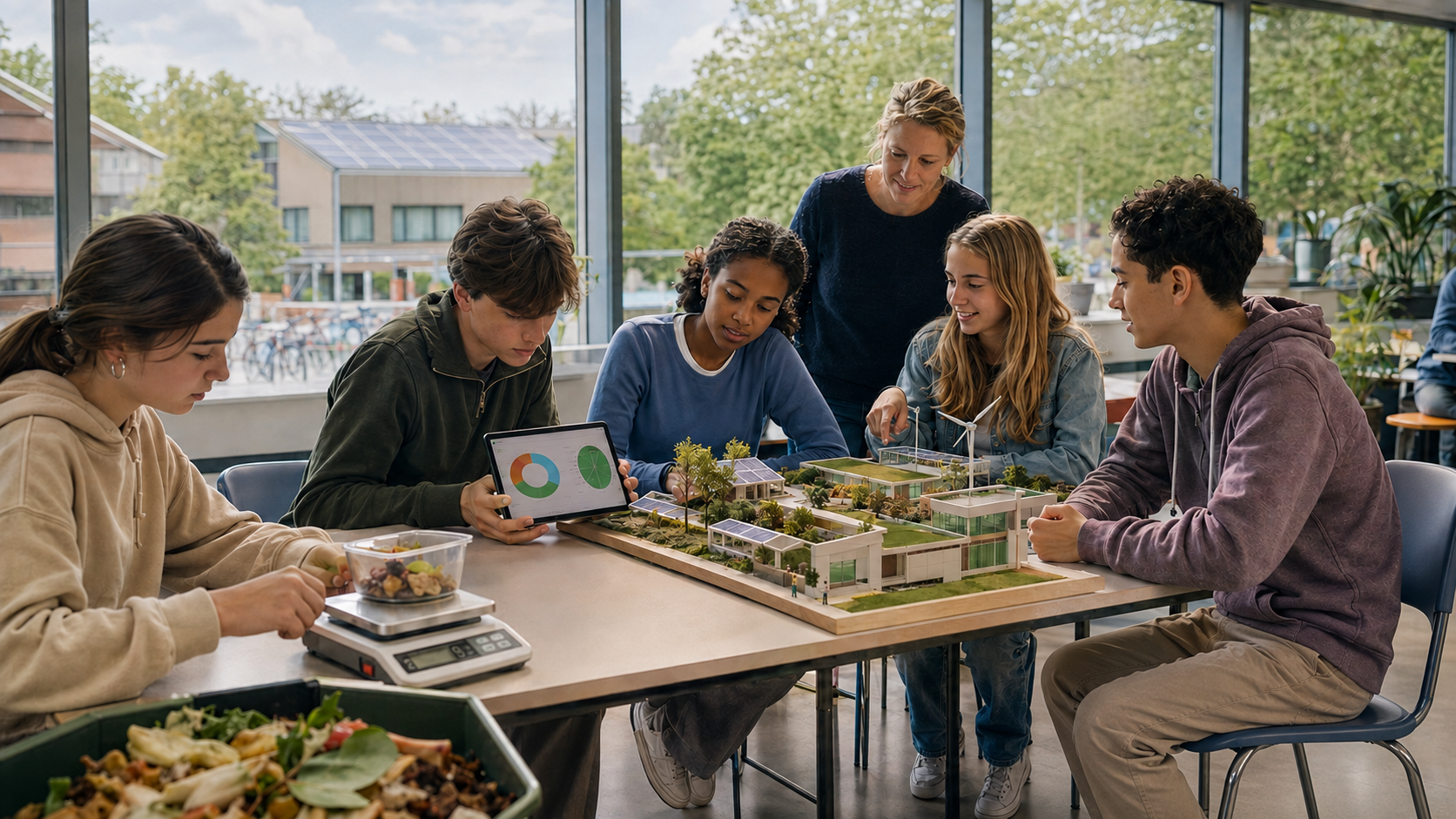
When we ask students what sustainability means, the answers often come quickly: protecting the environment, reducing waste, fighting climate change, and creating a better future.
These responses show that sustainability has become part of the vocabulary of younger generations. Yet there is another question that often remains unanswered:
How can we turn sustainability into action?
As sustainability becomes an increasingly important topic in education, schools have an opportunity to go one step further. Beyond helping students understand global challenges, they can equip them with the tools needed to address those challenges in a practical and measurable way.
This is where ESG comes in.
Sustainability Provides the Vision, ESG Provides the Framework
Sustainability describes the future we want to build. ESG—Environmental, Social, and Governance—helps us understand how to get there.
While sustainability is often discussed in broad terms, ESG translates principles into actions and indicators. It provides a framework to assess how organizations, projects, and institutions create value for people, communities, and the environment.
Think of it this way:
• Sustainability answers “Why does this matter?”
• ESG answers “How do we measure and improve it?”
By introducing ESG concepts, students learn that positive impact is not only about intentions. It is also about accountability, transparency, and continuous improvement.
Moving Beyond Awareness
Over the last decade, schools have done an important job raising awareness about climate change, social inclusion, and responsible consumption.
Awareness is the starting point, but it is not the final goal.
Students may understand that reducing waste is important, but how can they determine whether a school is actually becoming more sustainable?
This question encourages a different type of thinking—one focused on evidence and outcomes.
For example, students could:
• Monitor food waste in the school cantine
• Track energy consumption over time
• Measure participation in community initiatives
• Assess accessibility and inclusion within school activities
By collecting and analysing data, students move from discussing problems to designing solutions.
Why ESG Matters for Future Professionals
Today’s students will become tomorrow’s project managers, entrepreneurs, engineers, policymakers, and business leaders.
Regardless of their future careers, they will increasingly work in environments where sustainability performance is expected, monitored, and reported.
Organizations across sectors are integrating ESG criteria into their strategies and decision-making processes. Understanding these principles is becoming an essential skill rather than a specialized one.
Teaching ESG helps students develop competencies such as:
• Systems thinking
• Ethical decision-making
• Stakeholder engagement
• Impact measurement
• Responsible leadership
These skills are valuable not only in business, but in any profession that aims to create long-term positive impact.
Building the Next Generation of Changemakers
The challenges facing our societies today are complex and interconnected. Climate change, social inequality, resource scarcity, and rapid technological transformation require leaders who can combine vision with action.
Schools have a unique opportunity to nurture this mindset.
By integrating ESG alongside sustainability education, educators can help students understand that every decision, project, and organization has an impact—and that impact can be measured, managed, and improved.
The objective is not to turn every student into an ESG specialist.
The objective is to help young people become informed citizens and future professionals who are capable of transforming ideas into meaningful action.
A Call to Action
Are we giving young people the tools they need to turn sustainability into action?
Conclusion
Sustainability inspires us to imagine a better future, but ESG helps us turn that vision into reality. By introducing ESG concepts in schools, we can empower students to think critically, act responsibly, and understand how their decisions create measurable impact. If we want future leaders to address the challenges of tomorrow, we must provide them not only with values, but also with the frameworks and tools needed to put those values into practice.
The next generation is ready to shape a more sustainable world. Our responsibility is to ensure they have the skills to make it happen.
Short bio of the author(s):
Daniele Quadrellaro is a Strategy and Operations Specialist at the Future Food Institute, where he plays a cross-functional role in managing key projects such as Empower Women in Agrifood (EWA) and ESG4PM, alongside other initiatives. He holds a Master’s degree in Economics and Management of Sustainable Food Systems, as well as a Bachelor’s in Gastronomic Sciences, both from the University of Parma. He also completed an Erasmus exchange at Wageningen University & Research.
With a keen interest in entrepreneurship and innovation, Daniele won first place at the 2022 Techstars Startup Weekend Food Sustainability in Parma and received a special mention at the 2021 edition.
Passionate about food, Daniele views it as both endlessly complex and immediately accessible. To him, food is sophisticated pop.
Clarissa, born in Genoa but originally from central and southern Italy, is a nutritionist and pastry chef. A lover of nature, people and simple things, she believes that nutrition plays a fundamental role in creating a more equitable, healthier and more sustainable world. Fight against waste, sharing and consistency are its values; to be a drop in the ocean, her goal.
Only by restoring virtue to tradition and dialogue between cultures is it possible to innovate; the wisdom of our grandparents and research are the keys to leaving the world a better place!
Currently in charge of Education & Community Operation at the Paideia Campus in Pollica at Future Food Institute.