
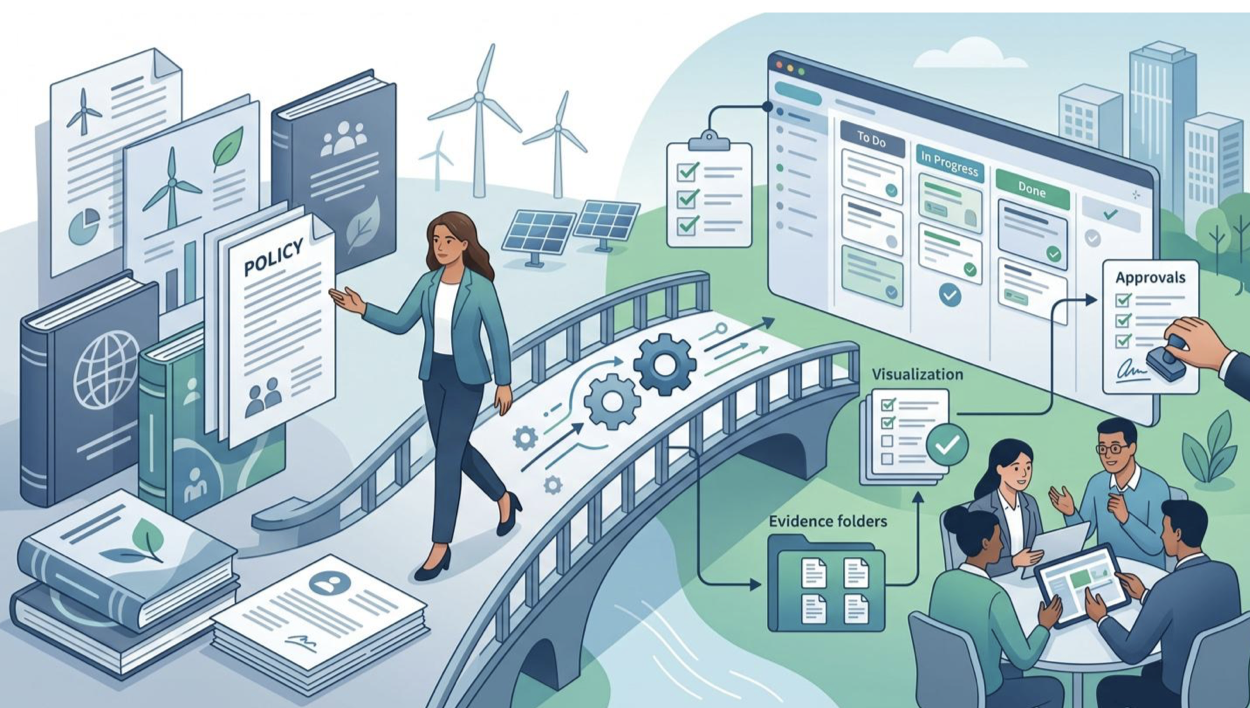
For many project teams, ESG starts as a regulation, a policy document, or a reporting requirement. It often arrives in the language of frameworks, standards, indicators, disclosures, and compliance. This is where project management becomes essential. The real challenge is not only understanding ESG regulation. The real challenge is translating it into daily work: tasks, responsibilities, evidence, approvals, timelines, and decisions.
In other words: How do we move ESG from “something we must report” to “something we actually manage”?
Regulation Is the Starting Point, Not the Workflow
EU regulation gives direction. It tells organisations what they need to consider, measure, disclose, or improve. But regulation does not automatically become action.
A project manager cannot assign a task called “comply with ESG.” That is too broad. It needs to be broken down.
For example, a regulation may require more transparency about environmental impact. In daily project work, this could become:
-collecting energy consumption data;
-checking supplier documentation;
-recording assumptions behind calculations;
-assigning responsibility for missing evidence;
-reviewing sustainability risks in project meetings;
-storing decisions in a traceable way.
This is the translation layer where the ESG requirement becomes a workflow and the workflow becomes tasks. Then the tasks become evidence from which they become reporting.And finally reporting becomes more credible because it is connected to real project activity.
Without this translation, ESG stays abstract. Teams may know that sustainability matters, but they may not know what to do differently tomorrow.
The ESG Workflow Mindset
A workflow is simply a repeatable way of getting work done.
In ESG project management, workflows help teams answer practical questions:
-Who collects the data?
-Who checks whether it is complete?
-Where is the evidence stored?
-When is the information reviewed?
-Who approves the final interpretation?
-What happens if something is missing, delayed, or inconsistent?
These questions may sound simple, but they are powerful. They turn ESG from a vague responsibility into a managed process.
A good ESG workflow should have five basic elements:
1. Trigger
What starts the workflow? A new supplier? A project milestone? A reporting deadline? A design change? A stakeholder complaint?
2. Responsible person
Who owns the next action? ESG cannot belong to “everyone” in general. If everyone is responsible, nobody is accountable.
3. Evidence
What proof is needed? This may include documents, calculations, meeting notes, supplier declarations, photos, policies, or system records.
4. Review point
When does the team check whether the task is complete and reliable? This could happen during project status meetings, stage-gate reviews, or monthly reporting cycles.
5. Decision or escalation
What happens next? Is the item approved, revised, escalated, or rejected?
This structure makes ESG more manageable. It also makes life easier for project teams because expectations become clear.
Turning ESG Topics into Project Tasks
One of the most useful things a project manager can do is break ESG topics into everyday project categories.
Environmental topics can become tasks related to resource use, emissions, waste, procurement, logistics, design choices, or lifecycle impact.
Social topics can become tasks related to health and safety, accessibility, inclusion, stakeholder communication, community impact, employee wellbeing, or training.
Governance topics can become tasks related to decision records, risk management, supplier due diligence, conflict-of-interest checks, data protection, approvals, and audit trails.
This does not mean every project needs a huge ESG checklist. That would create unnecessary bureaucracy.
The goal is to identify what is relevant for the project and build it into existing routines.
For example:
-During project initiation, define ESG risks and responsibilities.
-During procurement, check supplier ESG requirements.
-During planning, include ESG milestones and evidence points.
-During execution, monitor ESG indicators alongside budget and timeline.
-During closure, document lessons learned and unresolved issues.
This approach helps ESG become part of the project rhythm.
The best workflow is not the one that looks impressive in a presentation. It is the one that people actually use.
Digital Tools Can Help, But Process Comes First
Digital tools can make ESG workflows easier. They can support task tracking, document management, reminders, dashboards, reporting, and collaboration. AI can also help by summarising documents, identifying missing information, comparing requirements, or preparing draft updates.
But there is one important rule:
Do not automate confusion.
If roles are unclear, data is inconsistent, or evidence is scattered, technology will not fix the problem by itself. It may only make the confusion faster and harder to see.
Before introducing advanced tools, teams should agree on the basics:
-What ESG information do we need?
-Where does it come from?
-Who is responsible for it?
-How often do we review it?
-How do we know it is reliable?
-How do we document decisions?
Once these questions are answered, digital tools become much more useful. They support the workflow instead of replacing the thinking behind it.
For project managers, this is familiar territory. Good tools support good processes. They do not create them automatically.
A Simple Example: Supplier ESG Check
Let’s imagine a project that depends on several external suppliers.
At the regulatory level, the organisation may need to demonstrate responsible supply chain practices. At the project level, this can become a simple workflow:
Step 1: Supplier added to project
The workflow starts when a new supplier is selected.
Step 2: ESG documentation requested
The procurement or project team asks for relevant policies, certifications, declarations, or evidence.
Step 3: Documentation reviewed
A responsible person checks whether the documentation is complete and aligned with project requirements.
Step 4: Missing information flagged
If something is missing, the supplier receives a clear request with a deadline.
Step 5: Risk decision recorded
The team documents whether the supplier is approved, conditionally approved, or escalated for further review.
This is not complicated. But it is exactly the kind of practical workflow that turns ESG from a principle into action.
Conclusion
EU regulation sets the direction. Project management turns that direction into movement and for ESG to work in practice, teams need more than awareness. They need workflows that connect requirements with tasks, evidence, responsibilities, and decisions.
The goal is not to create more administration. The goal is to make ESG visible in daily project work.
When ESG becomes part of how projects are planned, executed, reviewed, and closed, reporting becomes more reliable. Decisions become more transparent. Accountability becomes easier to demonstrate.
So, the next time your organisation discusses ESG regulation, ask a simple question:
What does this mean for our project workflow tomorrow morning?
That question can turn compliance into action.
Marina Krstić is a Project Manager at Sparky* and co-founder with extensive experience in European projects and the management of complex, AI-driven initiatives. Her work focuses on bridging technology, sustainability, and business value, with a particular emphasis on delivering large-scale AI solutions in the finance and media industries.
#ESG #ArtificialIntelligence #SMEs #Sustainability #ProjectManagement #AIAgents #ESG4PMChange #DigitalTransformation