
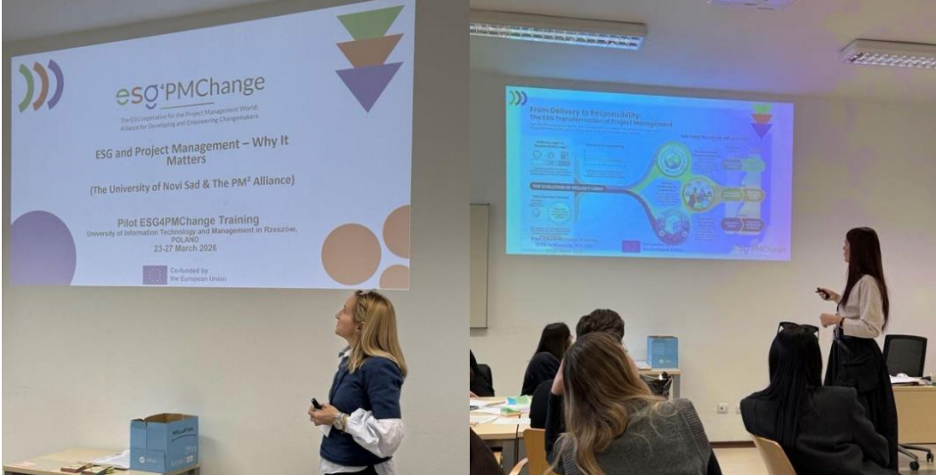
Higher education students had the opportunity to develop practical knowledge and skills for integrating environmental, social, and governance (ESG) principles into project management through the ESG4PMChange Pilot Training Program in Poland.
The program was organised by the University of Information Technology and Management (UITM) and delivered at its campuses in Rzeszów and Kielnarowa, in cooperation with the ESG4PMChange project partners SYNTEA, REVAS, UNS, PM² Alliance, UTH, UNIST, UNIBO, FFI, and AINS.
The activity formed part of the Erasmus+ project “The ESG Imperative for the Project Management World: Alliance for Developing and Empowering Changemakers – ESG4PMChange,” which aims to strengthen the competencies required for responsible and sustainable project management.
Learning Through Practice
The program combined lectures, workshops, teamwork, and simulation-based learning. Participants explored how ESG principles can be integrated into project design, planning, implementation, and performance monitoring.
Working in interdisciplinary teams, students developed project ideas using the ESG Project Canvas. They identified ESG challenges, stakeholders, objectives, risks, governance arrangements, and key performance indicators.
Particular attention was given to the practical value of ESG in creating responsible, sustainable, and successful projects, rather than viewing it solely as a regulatory requirement.
Realistic Challenges and Teamwork
A sustainability-focused business simulation enabled students to work through realistic project situations and assess the environmental, social, and governance consequences of their decisions.
Through teamwork and discussion, participants strengthened their skills in stakeholder engagement, risk assessment, social impact analysis, responsible decision-making, communication, and project performance monitoring.
The interdisciplinary format also encouraged the exchange of perspectives and joint problem-solving, reflecting the complexity of contemporary project environments.
From Knowledge to Sustainable Action
The pilot program demonstrated strong participant engagement and interest in ESG-related topics. Practical assignments and simulation activities helped students connect theoretical concepts with real-world project challenges.
The activity directly supports the objectives of ESG4PMChange by preparing future professionals to manage projects with a long-term positive impact on organisations, society, and the environment.
The presentations, simulation materials, and project outputs developed during the program will also contribute to the further dissemination of ESG4PMChange results among students, educators, trainers, and professionals.