
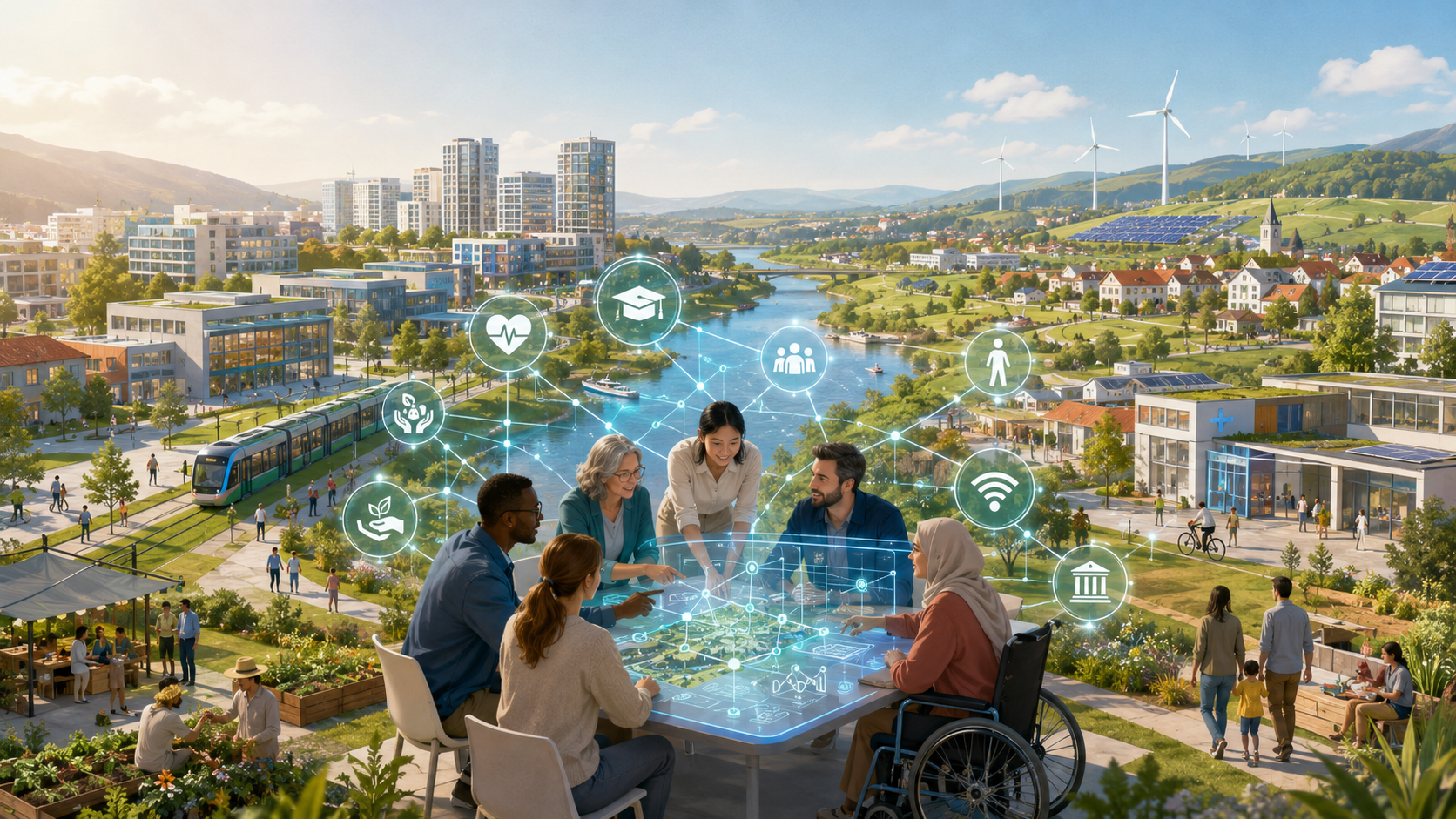
Can a region really thrive if its economic growth is achieved at the cost of its people or its environment? Governments, businesses and communities are facing ever more complex global challenges, from climate change and digital transformation to demographic shifts and social inequalities. Traditional indicators such as GDP are no longer enough to capture what makes a region successful.
Today, the future of regional development lies at the intersection of Artificial Intelligence (AI), Environmental, Social and Governance (ESG) principles, and data-driven well-being measurement. Together, these approaches are transforming how policymakers understand, monitor, and improve the quality of life across regions.
1. Beyond Economic Growth
For decades, regional development policies focused primarily on economic growth indicators such as income, employment, productivity and investment. While these remain important, they only present one part of the story.
Modern regional development increasingly considers questions such as:
• Are citizens satisfied with their lives?
• Do all citizens have equal access to education and healthcare?
• Is economic growth environmentally sustainable? Are institutions transparent and inclusive?
• Can regions adapt to future crises?
These dimensions form the foundation of sustainable and resilient regional development.
2. The Growing Importance of ESG
Originally created as an assessment tool for corporate sustainability, ESG has become a multidimensional approach that is used for policymaking as well. At the regional level, ESG helps policymakers assess:
Environmental Performance
• Climate adaptation and resilience
• Renewable energy adoption
• Air and water quality
• Biodiversity protection
• Sustainable resource management
Social Performance
• Health outcomes
• Education quality
• Employment opportunities
• Social inclusion
• Gender equality
• Community well-being
Governance Performance
• Institutional effectiveness
• Transparency
• Citizen participation
• Digital public services
• Accountability and trust
Those regions that score highly on each of these indicators tend to be more competitive at attracting investments and maintaining talents.
3. Why Artificial Intelligence Changes Everything
The challenge has never been the lack of data—it has been making sense of it. Every day, policymakers need to use data from public services, environmental monitoring, satellite imagery, healthcare systems, transport networks and citizen surveys. AI enables policymakers to transform these fragmented datasets into meaningful insights.
Artificial Intelligence can:
• identify emerging regional trends;
• identify vulnerable communities before crises;
• predict environmental risks;
• support evidence-based policymaking; and
• evaluate the long-term impacts of policies.
Rather than replacing human decision-making, AI enhances it by enabling faster, more informed and more transparent policy decisions.
4. Measuring What Really Matters
One of the most significant advances in regional policy is the growing use of composite well-being indicators.
Unlike single economic measures, like GDP, composite indicators combine multiple dimensions—including economic, environmental, social and institutional indicators in order to assess regions as a holistic system.
Examples of indicators that can be part of complex indicators, include:
• life satisfaction;
• self-perceived health;
• educational attainment;
• environmental quality;
• digital connectivity;
• civic participation;
• governance quality.
These pillars of development allow policymakers to identify not only which regions are growing, but also which regions are characterized by a good quality of life.
5. AI Meets Well-Being Analytics
Artificial Intelligence makes these complex measurements far more powerful, because machine learning techniques can:
• uncover hidden relationships between variables;
• cluster regions with similar development profiles;
• identify the strongest drivers of well-being;
• predict future regional performance;
• evaluate the effectiveness of public investments.
For instance, using AI technology can help identify that better governance and education would have more effect on the quality of life of citizens than temporary economic gains in the region.
The government would then use this knowledge to invest wisely and make decisions accordingly.
6. Building Smarter and More Resilient Regions
The regions which will thrive in the next decades are not necessarily the ones with the highest GDP but those that will be able to:
• be economically competitive;
• environmentally sustainable;
• inclusively social;
• have well-developed institutions;
• be innovating technologically
• use data-based decision making.
AI can offer the tools, whereas ESG the framework of development and the pathways to be followed
Together, they help governments to create not only efficient economic policies but also socially equitable and environmentally sustainable ones.
Conclusion
Artificial Intelligence does not define the future of regional development—how we use it does. When combined with ESG principles and meaningful well-being indicators, AI becomes a powerful tool for creating regions that are not only developed, but also healthier and more resilient.

Ms. Foteini Papadioti is a researcher at the University of Thessaly, specialising in regional development, European public policies, sustainability and innovation. She holds a Diploma in Engineering in Planning and Regional Development, an MSc in New Entrepreneurship, Innovation and Development, and is pursuing a PhD on regional well-being. Her work combines research, policy and data-driven approaches to support sustainable and inclusive regional development.