
ESG is no longer a topic reserved only for strategies, reports, and corporate boards. More and more, sustainability is implemented where everyday decisions are made — in projects.
This is why project managers play a key role in sustainable transition. They translate broad ESG goals into concrete activities: planning, budgeting, procurement, stakeholder communication, risk management, and reporting.
This blog draws on findings from research conducted within the ESG4PMChange project, involving 735 project professionals from 15 European countries. The research shows an important conclusion: project professionals recognize the importance of ESG competencies, but their practical application still lags behind.
In other words, the problem is not that ESG is seen as unimportant. The challenge is that teams often do not yet have sufficiently developed competencies to implement it effectively.
ESG competencies are not an “extra” add-on
In traditional project management, success has often been measured through the familiar triangle of time, cost, and scope. Today, this is no longer enough.
A project may be delivered on time and within budget, but if it creates negative environmental impacts, overlooks community needs, or lacks transparent governance, can we really call it successful?
This is why ESG competencies are becoming part of the core skill set of modern project managers. They help teams think beyond delivery and ask not only “How do we complete this project?”, but also “What impact does this project leave behind?”
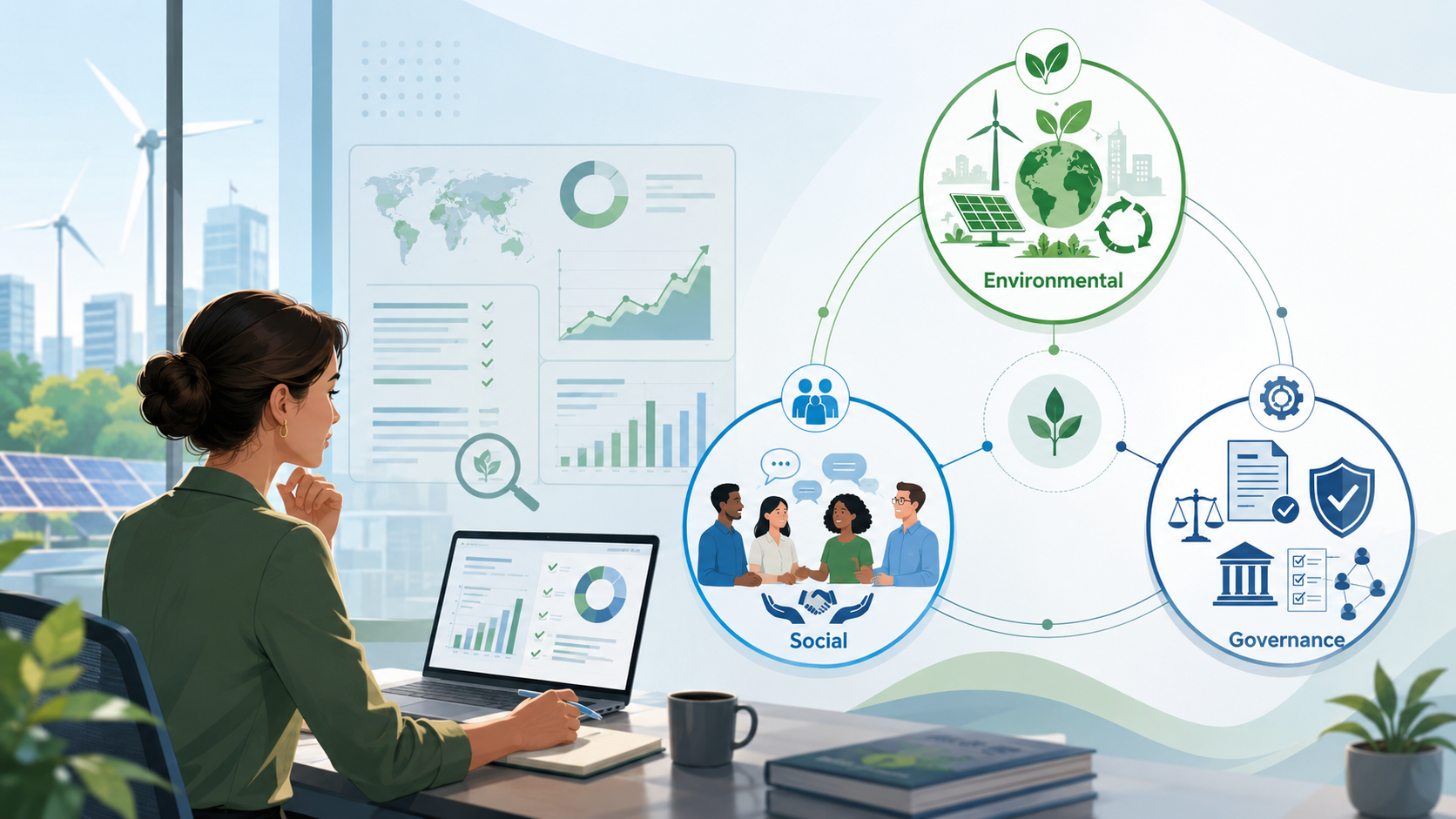
The research examined three groups of competencies:
Environmental — how the project affects the environment
Social — how the project affects people and communities
Governance — how responsibly and transparently the project is managed
Environmental: How does the project affect the environment?
Environmental competencies refer to the project team’s ability to reduce the negative ecological impacts of a project. This includes efficient use of resources, waste and emissions reduction, sustainable procurement, green technology integration, and life-cycle thinking.
In the study, environmental competencies were rated as important, with an average importance score of 3.77 out of 5. However, their average performance score was lower, at 3.33. This shows a clear gap between what project professionals consider important and what is actually applied in practice.
The most visible challenges were identified in areas such as:
✔️ green technology integration
✔️ innovation in environmental practices
✔️ Life Cycle Assessment
✔️ sustainable procurement from an environmental perspective
For project managers, this does not mean becoming environmental experts overnight. But it does mean knowing how to ask the right questions:
Are we using resources efficiently?
Does our choice of suppliers affect the project’s environmental performance?
Are we considering the impact of the project across its entire life cycle?
These questions can change the way a project is planned, managed, and delivered.
Social: Projects are not only for people — they are done with people
The social dimension of ESG focuses on people: project teams, users, local communities, suppliers, and other stakeholders.
It includes stakeholder engagement, occupational health and safety, diversity and inclusion, human rights, social impact, and grievance mechanisms.
In the research, social competencies received an average importance score of 3.86, while their average performance score was 3.47. This again confirms a gap between perceived importance and practical implementation.
Some of the most notable gaps were found in:
✔️ human rights due diligence
✔️ community impact and development
✔️ inclusivity in decision-making
✔️ grievance mechanisms
✔️ social reporting
This sends an important message to project managers: a project is not only a technical task. It affects people, working conditions, trust, safety, and the sense of inclusion.
For example, in an infrastructure project, it is not enough to ask, “Is the technical solution good?” We also need to ask: “Who will be affected by this project? Have they been included in the process? Do they have a channel to raise concerns?”
Governance: Rules, responsibility, and trust
Governance competencies were rated as the most important in the research. Their average importance score was 4.20, higher than both the environmental and social dimensions.
However, governance also showed the largest gap between importance and performance. The average performance score was 3.54, with an overall gap of 0.655. This means that project professionals clearly recognize the importance of responsible governance, but organizations and teams are still not applying these competencies strongly enough.
The largest gaps in the governance area were found in:
✔️ training in governance and ESG standards
✔️ innovation in governance practices
✔️ legal and regulatory awareness
✔️ ESG reporting and disclosure
✔️ integration of ESG into governance processes
In practice, governance means knowing who makes decisions, who is accountable, how ESG indicators are monitored, how communication with stakeholders is handled, and how ethical dilemmas are resolved.
Without this, ESG can easily remain a formal obligation. With strong governance competencies, ESG becomes part of everyday project decision-making.
What can project managers do right away?
The good news is that ESG competencies do not have to be developed all at once. A useful first step is a simple self-assessment:
✔️ Which ESG topics are most relevant to my project?
✔️ Where does our team already perform well?
✔️ Where is the biggest gap between what we know is important and what we actually do?
✔️ Do we need training, better processes, or clearer accountability?
ESG competencies are not a passing trend. They are becoming part of the professional identity of project managers.
Every project manager should therefore understand three basic questions:
Environmental: How does my project affect the environment?
Social: How does it affect people and communities?
Governance: Is the project managed responsibly, transparently, and ethically?
A good first step may be simple: look at your current project and ask yourself — which one ESG competency should our team strengthen right now?

Bojana Savić
Teaching Associate and PhD student in the field of Project Management, with academic and research interests focused on ESG integration, sustainability, and the development of future-oriented project management competencies. She holds master’s degrees in Project Management and Traffic and Transport Engineering, and is actively involved in international education and research initiatives.