
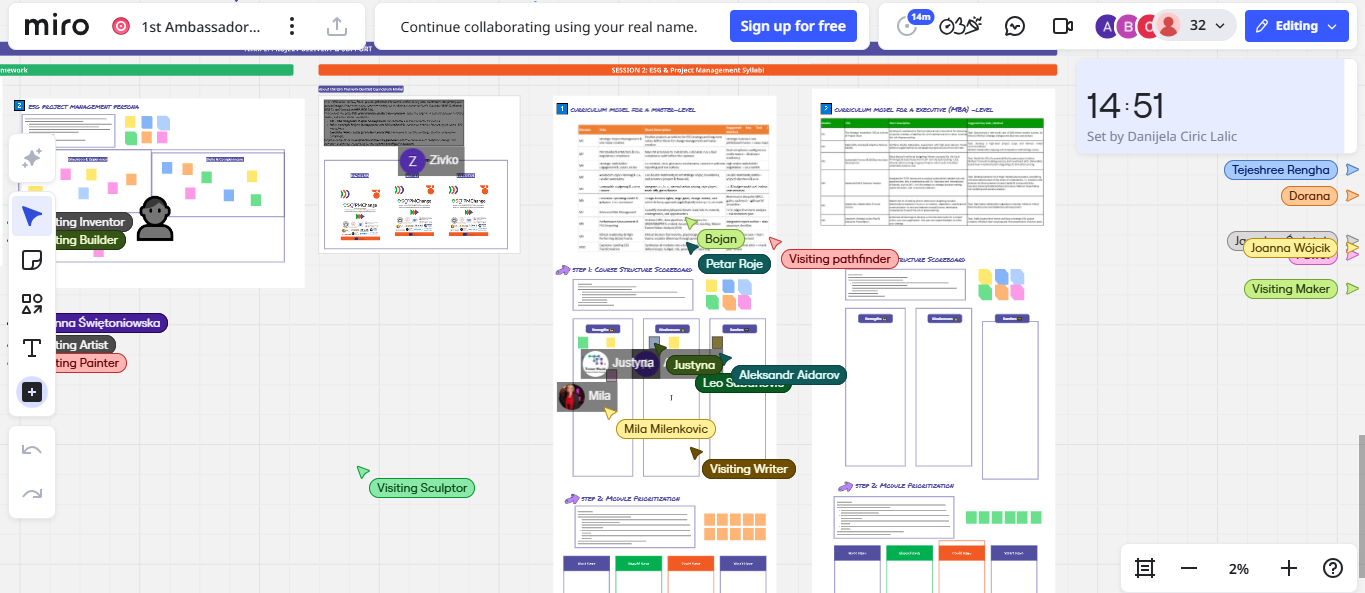
The first ESG4PMChange Ambassador Workshop successfully brought together a diverse and international group of professionals, educators, researchers, industry representatives, and sustainability practitioners with a shared goal: to validate and enhance the project’s core deliverables and empower the newly established Ambassador Network.
Organised by the University of Novi Sad, the event provided a highly collaborative space for co-creation, dialogue, and knowledge exchange. By initiating and hosting this ambassador initiative, UNS strengthened the project’s capacity to integrate real-world insights, ensuring that the ESG competency framework and educational programmes are aligned with European labour market needs and sustainability transformation trends.
The workshop was designed to achieve several key goals:
Validation of the draft Professional Profiles and ESG Competency Framework (D2.2) through direct consultation with external stakeholders.
Refinement of draft syllabi for Bachelor, Master, and Short Courses (D3.1) to improve learning outcomes, pedagogical consistency, and practical relevance.
Collection of structured, experience-based feedback to ensure the deliverables reflect industry standards and sector-specific realities.
Expansion and empowerment of the ESG4PMChange Ambassador Network, positioning ambassadors as key multipliers for visibility, dissemination, and long-term adoption.
Clarification of next steps, including piloting, training, and continued ambassador engagement.
The workshop truly felt like co-creation in action. It was inspiring to see academia, industry and public-sector experts shaping the future of ESG competencies together.
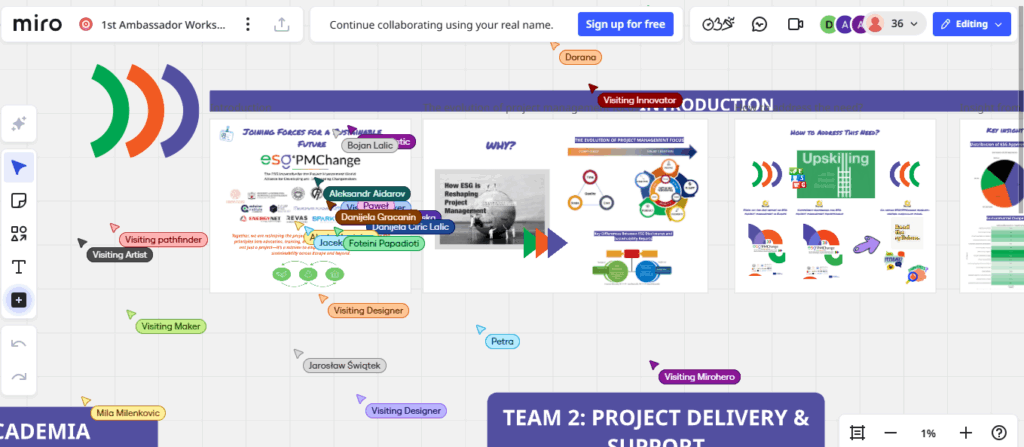
The workshop was structured around interactive and thematic sessions rather than traditional presentations. It included:
An introductory briefing by the University of Novi Sad
Two main validation sessions focused on D2.2 (Competency Framework) and D3.1 (Curricula)
Three working groups:
Academia
Project Delivery & Support
Business & Consulting
A concluding reflection session on takeaways and upcoming activities
Through hands-on tasks, ambassadors identified practical application contexts for the ESG Competency Framework, outlined the characteristics of the ideal ESG Project Manager, and evaluated the newly designed BSc, MSc, and MBA curricula.
The discussions highlighted the importance of interdisciplinary pathways, sector-specific requirements, and the growing demand for ESG-oriented leadership and digital skills. Input from participants significantly contributed to refining the deliverables ahead of their upcoming piloting phase.
Key Insights from Group Work
Ambassadors generated clear and actionable proposals, including:
Diverse use cases for applying the ESG Competency Framework in higher education, VET programmes, consulting, procurement, HR processes, and public governance.
A detailed outline of the ideal ESG-driven Project Manager, characterised by interdisciplinary expertise, systems thinking, ethical leadership, and advanced digital capabilities.
Comprehensive feedback on BSc, MSc, and MBA curricula—recognising strong alignment with policy and industry needs while recommending enhancements such as more simulations, data-driven tools, and ethical decision-making components.
The multi-sector format allowed theoretical inputs to be tested against real organisational conditions, resulting in refined, practical outputs.
Participant Profile
The workshop brought together a highly diverse group of professionals and institutions, creating a rich and multidimensional environment for discussion and co-creation. Participants represented a broad spectrum of sectors, including universities and research institutes, international companies, consulting organisations, public-sector bodies, NGOs, and sustainability-oriented organisations.
Their professional expertise spanned project management, environmental protection, procurement, digital transformation, innovation, strategic leadership, banking, logistics, and education. This wide range of perspectives ensured that the project deliverables were examined from academic, corporate, policy, and operational angles.
Such diversity proved to be one of the workshop’s greatest strengths. It enabled balanced, evidence-based validation of the competency framework and curricula, while the high level of engagement demonstrated the ambassadors’ strong motivation to remain actively involved in the upcoming piloting, training, and dissemination phases of the project.
Feedback and Observations
Participant satisfaction with the workshop was exceptionally high, with ambassadors consistently highlighting the clarity and well-structured nature of the activities, as well as the depth of interdisciplinary exchange that enabled meaningful dialogue across sectors. Many described the experience as one of genuine co-creation, noting that they felt actively involved in shaping the project outputs rather than simply reviewing them. The logical progression of the curriculum from BSc to MSc and MBA levels was also praised, alongside the strong alignment of proposed competencies with current and emerging ESG trends.
In addition to positive impressions, participants offered a range of constructive recommendations aimed at strengthening the deliverables. These included further development of digital and analytical competencies, clearer links between each competency and its organisational application, and the enhancement of curricula through quantitative tools, ethical dimensions, stronger industry collaboration, and the use of real-data case studies. Ambassadors also emphasized the importance of acknowledging institutional barriers that may affect curriculum implementation in different educational contexts.
Taken together, this feedback provides a clear and actionable roadmap for refining the next iteration of deliverables and establishes a strong foundation for the upcoming piloting phase of the ESG4PMChange project.
The 1st ESG4PMChange Ambassador Workshop represents a major milestone in the project’s development. It validated essential deliverables, expanded the ambassador community, and strengthened the alignment between project outputs and real-world needs.
Most importantly, it fostered a collaborative, forward-looking environment that will continue supporting the project’s sustainability, visibility, and long-term impact across Europe.